I Thought the Right City Would Keep My Daughters Safe
After the Covenant School shooting in Nashville, I left. What I was really trying to protect wasn’t just them.

Three years ago, in the aftermath of the Covenant School shooting in Nashville, I did what a growing number of American families are doing privately right now: I began planning our exit.
That night, I stood in my five-year-old daughter’s doorway and watched her sleep. She was sprawled sideways across her bed, one arm flung above her head. The soft glow of her star projector drifted across the ceiling—moons and constellations looping in slow orbit.
The room held its shape, as if nothing had changed. Inside me, everything loosened and frayed. My thoughts kept circling a single, unbearable possibility: that she might be here one morning and gone the next.
Earlier that day, just miles from our home, six people had been killed at The Covenant School. Three were nine-year-old children. An hour after I dropped my own daughter at school, a rifle designed for war had been carried into a building that looked so much like hers that I could not get myself to stop picturing her inside it—her backpack on its hook, her head bent over a drawing, her tongue caught in concentration.
News reports described Covenant as one of Tennessee’s deadliest school shootings that year. One of, I thought.
In the days after, as the world outside of Nashville moved on, the grief felt local—visible in small nods between strangers in ordinary places. No one said much, but everyone seemed to understand: it should never have happened here.
As a community organizer, I did what I knew how to do: I brought people together. I posted a simple flyer on Instagram inviting anyone who needed somewhere to put their grief to gather for a silent vigil. We called it the Mourners Walk. Within hours messages poured in from people asking where to meet and how to help.
For the next two days I barely slept, my phone warm in my hand as I secured permits and confirmed speakers, and answered messages from people asking if they could come. The logistics gave my grief and anxiety somewhere to go. As long as I was moving, it felt contained.
By the time the vigil began, the crowd was already spilling past the block and into the surrounding streets. Candles were passed out and soon flickered along the sidewalks, their glow uneven against the dusk. News vans idled at the curb, cables stretching across the pavement while reporters spoke in low tones and families gathered close.
Elected officials spoke first. They stepped forward and offered what we have all come to expect—thoughts and prayers. I remember thinking, almost incredulously, that after all these years, after all the criticism the phrase has received, this was still the language. Dr. Jill Biden stood grimly in the background, and Sheryl Crow and Margo Price sang.
After everyone finished and folded their notes, they quietly walked back toward City Hall, leaving the crowd suspended in silence.
“Was that it?” I heard someone whisper.
No one returned to the microphone. No other words of comfort or action were coming.
So we began the Mourners Walk.
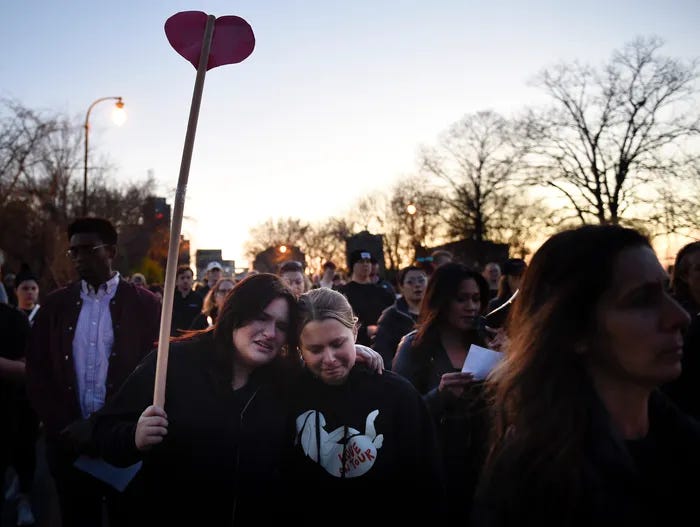
Standing shoulder to shoulder through the streets of downtown Nashville steadied me in a way nothing else could. We spoke the names of those lost that year to gun violence, each carried into the quiet before the next. The only other sound you could hear was our footsteps moving through the dark. People wept openly as we walked, holding one another as the grief settled in—not only for the lives that had been lost and the families who loved them, but for the understanding that we could gather like this again.
In the days that followed, nothing shifted in any lasting way. The headlines moved on, but the grief and the fear did not.
I wondered whether my family and I should leave.
The instinct was not unfamiliar to me. I grew up understanding that you must always move toward the life you hope is possible. My parents came to this country searching for steadier ground—more opportunity, more possibility than the lives they had left behind. They never framed that decision as fear. It was love.
I have to admit, the thought filled me with shame. For the past few years, I had been organizing in Nashville—standing firm, pushing back, urging others to do the same. I had just addressed a crowd at the Mourners Walk, calling on our community to stay united. And now I was considering leaving, as if I were abandoning the work the moment it became difficult.
Yet at the same time, it felt like the most responsible choice. Our daughters were still so young—our youngest not even two. We hadn’t been in Nashville long. We had no family nearby, no deep roots anchoring us to the city. And even though I had made a home there—a home I loved and had poured my heart into, from the garden in the backyard to the floral wallpaper in the girls’ rooms—not even that was enough to hold us.
Night after night, as my husband and I turned the decision, we asked ourselves the same question: if we had the chance to build a safer life for our daughters, why wouldn’t we? In those months, as we spent long hours talking it through and imagining what that life might look like, I loved my husband deeply, certain we were standing shoulder to shoulder in the most important work of our lives. The move didn’t feel like an escape. It felt like a commitment to the family we were building.
And just like that, weeks after the Covenant shooting, we decided to move back to New York City—and we were moving very soon. With that decision in place, I threw myself into planning the next chapter of our lives with the kind of focused urgency mothers bring to their children’s well-being. I sorted through our home piece by piece—organizing garage sales, scheduling movers, deciding what we could carry and what we had to let go—while, night after night, long after everyone else was asleep, I researched schools and neighborhoods, messaging other parents about dismissal routines and what daily life in those communities really felt like.
I wasn’t trying to build a perfect life—I knew it didn’t exist. But I was aiming for something more aligned: a place where I wouldn’t get double takes walking into a room, as if they had never seen someone like me before; where my daughters would grow up among children who looked like them; and where the laws—from guns and reproductive rights—offered a measure of protection. I thought that if I chose carefully—the right block, the right school, the right closeness to community—I might be able to narrow the field of harm.
When we landed at JFK and walked beneath a sign that read Everyone Is Welcome Here, my throat tightened. It was only a banner stretched across an airport corridor, but in that moment it felt like the city itself was greeting us. Passing beneath it, I felt for a moment as though we were stepping into a life that had been waiting for us.
A few months later, my husband told me he wanted a divorce.
There had been no long unraveling, no slow warning. It shifted in a way that altered the shape of our home almost overnight, and it broke my heart in a way I had never known before.
Suddenly we were dividing our time with the girls in half, money slipping out the door to attorneys and new apartments, all while trying to navigate daily life with someone I felt like I no longer recognized. I held my oldest close as she sobbed in her sleep. In the blur of handoffs and transition bags, I sometimes realized I had forgotten something small but essential—a baby bottle, a favorite stuffy.
Even in the midst of it all, I was grateful we were there. Our community held us—me and the girls—an army of love showing up in small, steady ways, helping me carry what felt impossible to carry alone, enveloping us in care and reminding us we were never alone.
But New York did not quiet my fear the way I had imagined. There were still lockdown drills at my kids’ school. I remember the first time they described practicing how to remain silent in a dark classroom—the tightening in my chest felt achingly familiar. I still caught myself scanning exits at the movie theater and watching the doors when adults entered the school building. The laws were different, but vulnerability, it turned out, could travel across state lines.
For years, I had believed that if I researched enough and planned carefully enough, I could shield the people I loved from rupture. I thought that the right place might allow love to do the rest. But no carefully chosen neighborhood could steady what had already come undone.
Three years have passed since Covenant, and the world feels even more unsettled. Nearly every day brings another headline about another shooting somewhere, another law narrowing what feels possible for women and girls, and for our trans and queer friends.
These days, I hear people talking about leaving—friends, neighbors, parents in the same Facebook groups. Many already have.
And while I understand the impulse, I also understand that leaving did not deliver the kind of certainty I thought it would. Even so, life here in Brooklyn has become something I love. I’ve learned to move through it differently—paying closer attention to the small ways people show up for one another: neighbors swapping information about local elections, opening their homes for gatherings to support new leaders, parents organizing around school safety, the steady civic work of people who still believe their communities are worth shaping.
Our own small offering sits in the apartment window. A sign my younger daughter made is taped to the glass so others can see it. In careful letters it reads: You Are Loved. When the afternoon light hits the glass, the words glow faintly. Sometimes I wonder if they might meet someone passing by the way that airport sign once met me—an unexpected reminder that even in an uncertain world, love still finds its way into the open.
It took me longer than I wish it had to understand that the right place would never quiet my fear. What I needed was a way to live with it.
I still stand in my daughters’ doorways at night, listening to the steady rhythm of their breathing. The room holds its shape. The world beyond it does not.
Cities change. Laws change. Homes change, too. What I can do is remain—in the doorway, in the uncertainty, with them. The world may never feel safe, but loving them means staying anyway.